Thursday, March 21, 2013

Home made in Bhutan


Home made in Bhutan

Surly there are a number of places in the world where traditional methods of doing things are still in practice but likely not many where those traditions are still so much the norm and fully supported by the culture and the government which are one and the same.
            So, the fellow next door, Pema, our school driver and catch all employee, has a young family and wanted some furniture. Earlier in the season he purchased a batch of walnut from a tree felled a few villages over. This wood is stacked behind our building with stickers so it will stay dry. The pieces are large, 3 or 4 inches by 12 to 16 inches. An amazing amount of walnut by any modern standards. After acquiring the wood he hires a carpenter for whom he has erected a substantial tent shelter in the back yard. In this tent the carpenter begins by turning the rough wood into dimensional lumber suitable for furniture. This involves a huge amount of planing, by a power planer when it is working and large block planes when it is on the fritz. Mortise and tenon joints are then hand cut into the dimensional lumber. As they are fit and glued together simple furniture is produced that is handsome walnut, very functional, and should last a lifetime.
            Another Bhutanese tradition which affects me daily is the national dress. In school’s all the students and all the Bhutanese teachers wear Kira, for ladies, and Gho, for gents. I wear Gho daily to teach in as a show of respect for and interest in the Bhutanese culture. I hope the Bhutanese reputation for being genuine is true and that the comments I have heard that, for a foreigner, I wear Gho pretty well are true and not just being nice. Anyway, every Gho starts out as raw material and is made in Bhutan. Most are custom made but it is possible to buy one off the shelf if it fits. Hard to imagine that a garment which looks like a giant, shapeless cape can be sized but I have learned as one of mine is smaller than the other and they do go on differently. Every morning one must take this huge, shapeless cape and construct the national dress which is very specific. Like the hand hewn mortise and tenon every day the Gho must be shaped, tucked, and adjusted just so to be presentable. It is all held in place by a belt, again just a flat woven strap which has no buckles or other methods of holding together. Extra tight is the correct adjustment, ends tucked in just so. The whole belt is covered by a large fold of the Gho so that it should never be seen even though they are of brightly colored patterns . Still today the Gho is just material sewn in a certain way, no snaps, buttons, or zippers, just tradition. The Gho is required daily dress for most jobs in Bhutan, including taxi drivers. So it is around all the time, not a ceremonial garment to be brought out only at certain times.
            Any society which not only tolerates but values hand made furniture and national dress which must be created daily is a society which is worth getting to know a bit and worth preserving provided the Bhutanese continue to value their traditions. So far that seems to be the case. Meanwhile I will keep practicing, I can do it well enough by myself about half the time. Very often I need adjustment or an entire remake in the morning.
All this is not to say Bhutanese are not attracted by modern marketing and all sorts of cheap, poorly made products along with junk food. Coke products are fairly new here and the red and white Coke signature is becoming quite noticeable in the country’s somewhat abundant litter. I would think that a company like Coke would be sensitive to its image if not its contribution to the litter problem. Many tourists will see the red and white logo and form their own opinions. Bhutan should be a place where recycling fits in with many national goals. Plastic is still not being recycled effectively throughout Bhutan although it has begun in a few areas. Deposits on containers, reusable glass, etc should all be options that would be nice to see before Bhutan joins the rest of SE Asia much of which is covered in endless litter. So come on Coke, do your part!
No luck with pictures today, I'll try to add some later.


Tuesday, February 26, 2013

Trip to Gasa


            Pack up, head out on the road for a weekend. A wonderfully American thought. Join up with a few other BCF teachers, head toward Gasa, see what happens. Seems like a perfectly good plan. Bhutanese would disagree, they do not take travel lightly. Many whom I work with have not been to Gasa, which has only been opened up with a road in the last few years, before that it was a trekking destination. On the other hand there are a lot of Iowans who have never left the vicinity either. I go downtown Gaselo, a wide spot in the road which is the driveway to the lower school and just below one of the larger shops. I have not been able to arrange a ride so I settle in for a wait, hoping for a passing car to have room, a taxi perhaps, or one of the school drivers who said he was going down later in the evening. One line in my journal and my phone rings and it is VP (vice principal Sangay Kandu) saying he’s on his way and will pick me up. WOW! On the way we, that is those in the back seat, squeeze in 3 students headed down the hill as well. So I am in Bajotung with time for a bit of shopping for black knee socks (Gho attire) and an enjoyable beer. Taxi to Punakha and we begin to rendezvous. I join two other teachers for tea at a neighbors then it is off to Kurutung for dinner at the best little Indian restaurant in the valley. By the end of dinner six of us have gathered and we go back to the teachers quarters and have wall to wall sleeping bags for the night.
            Morning is breakfast out of the tiny kitchen with limited supplies and five of us are off to Punakha to bargain for a taxi. We strike a deal and squeeze in. Several hours later, which include one construction delay, we find ourselves in Bgishong where there is a new school and another BCF teacher with floorspace. A wonderful afternoon stroll and dinner by candlelight, electric out for a week or so, is followed by gathering ‘round the bukhari (wood stove).
            Next day we have all gathered out version of where the hotsprings are and decide we will try to hike there. Two hours later some of us are running out of steam and we take a rest beside a tiny roadside shop. He happens to be a taxi man but his wife is away and he’s watching the kids. But within the hour of our considering the options he is able to take us and give us directions to walk down to the springs. Although washed out in a flood a few years ago the tubs are rebuilt and a small tent community shelters many Bhutanese families who prefer to come for a week or so. A new temple is also there as many monks are among the bathers. I enjoy a nice soak next to an elderly man who chants gently and sets the perfect tone for the afternoon.
On the way home our original taxi driver had run low on oil but had arranged for another ride when we reached the trailhead. Amazing. Another wonderful dinner is enjoyed in the warm candlelight. One of our group gets an early morning phone call from our Punakha taxi man, he had driven up the night before and slept in his van! All the group’s worries about getting back with enough time to reach our various destinations evaporate as our taxi man winds his way downward and invites us for tea at his house which we pass on the way down. We had met his wife and son along the road on the way up and they are wonderful hosts and their son enchanting.


            I have time to shop in Bajotung and Pema helps me get all the way home before dark. No electric or water when I return but all is restored before long. Seredipity? Karma? Good vibes? The whole flow of the weekend was perhaps a reaffirmation of why traveling in a place like Bhutan is worth the effort. We all agreed with the national slogan, “Happiness is a Place”, and it was everywhere we were this weekend.

King's Birthday


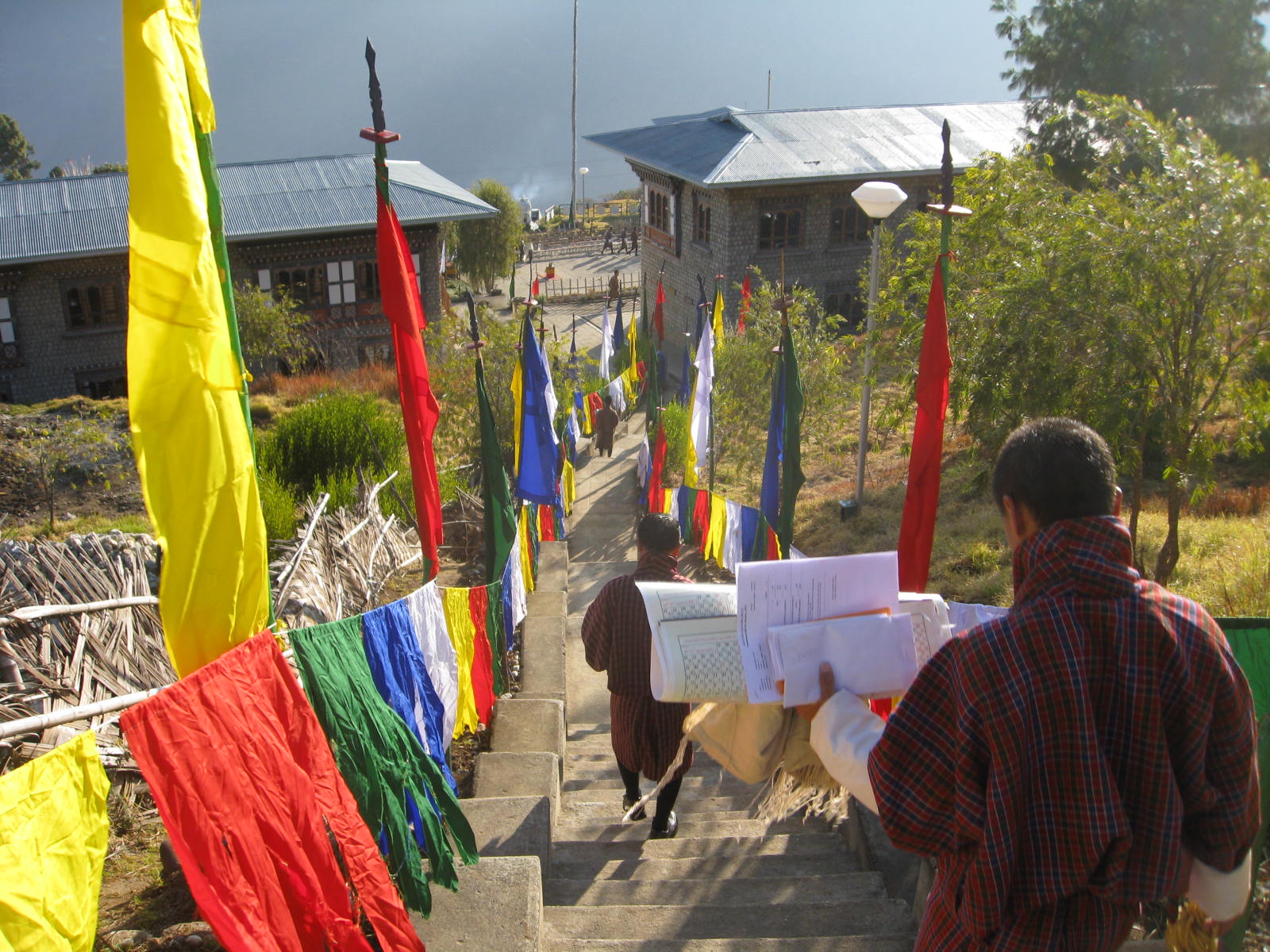
The first week of having students at school culminated with a celebration for the King’s Birthday. At Gaselo HSS this is a full blown affair. The day before was spent rehearsing, setting up a tent with 6 postholes dug with only a ‘spud’ bar, planting a hundred or so flagpoles with those same digging bars, decorating an altar which included 108 butter lamps, putting 400 chairs out. Each student brought their chair from class so they knew exactly where to sit, in their chair.
Rehearsal day was cool and cloudy with a bit of rain in the afternoon. The following day dawned flawlessly blue, an auspicious day indeed. Purifying cedar smoke wafting over the courtyard as final preparations were made. The ceremony included the principal guest, many speeches, a section devoted to academic awards for students based on the results from the previous year with quite a few awards which was nice. Another large portion of the program was a cultural performance of song and dance performed by the students, both traditional and contemporary pieces were featured. Unbeknownst to me I was considered a guest and ushered to a front seat to enjoy the celebration. Ushered into the group lighting the butter lamps, and ushered into the final circle dance which is a traditional thank you. Fortunately the steps were pretty easy to pick up and I survived with only a moderate amount of bumbling, however it would have been good to have been let in on the idea during the practice run through the day before. All this did earn me an early spot in the lunch line, and true to form the lunch was a celebration as well. So, satisfyingly well fed and happy after a wonderful morning I was ready to set out for my holiday excursion to Gasa with other BCF teachers.


Wednesday, February 20, 2013

Getting Started

Front gate , Gaselo HSS

During four days of faculty meetings as a group with everyone present and participating if they desire we have generated teaching assignments for subjects and grade level along with out of classroom responsibilities. We spent a lot of time working through a discipline policy which was new to the school last year. It is quite detailed and reflects the conservative values of Bhutanese society. At least the generation that is now parents, teachers, etc. There is a lot of emphasis put on the youth of the country in terms of how to keep them oriented to traditional basic values while they are assimilating themselves into the 21st century. The teens confront these issues primarily through all the access to other cultures via the internet and TV. These avenues give glimpses into other cultures but in a completely sterile context which involves no person to person interaction. This allows the kids to develop their own impressions of what is going on in the rest of the world without the benefit of input from anyone who is involved in those things. The balance between tradition and progress is one which few cultures have managed gracefully. Bhutan got a rather late start due to its isolation and is trying very hard to learn from examples, many of them failures, set in other parts of the world.
The faculty meetings ended up with some in service where teachers who had been to work shops presented to the faculty. The presentations were perfunctory and rather brief. One of these was on life skills. As they are trying to mold their discipline system to be more in line with contemporary western models it would have been good to spend a bit more time developing these thoughts. I believe there will be follow up as the year goes on which could be good as well. Perhaps the biggest challenge of the week for me was lunch, yummy food, no utensils save the ones we were born with. I didn’t starve nor did I make too big a mess.
The suburbs of my village, Gaselo
Saturday afternoon and Sunday were free time. After a long dry stretch, during which the air had become hazy, I think with dust, smoke, etc the rain came washing the air clean, the views of the Himalaya with fresh snow have been fine indeed. Sunday afternoon I watched the road from my window as vehicle after vehicle, as varied as one could imagine plied their way up the road, 7 miles of winding, bumpy, rocky road to drop students off at school. Most of the 500 students are boarding students. While in Thimphu we had shopped for all of our household belongings, mattress, rice cooker, etc, etc. Many times I saw young people buying the same things. They were preparing to go to school for a year just as I was.
Saturday evening, faculty gathered in the school “canteen” which is a private store/restaurant in the Bhutanese style. All sat on low benches, wood stove in the middle of the room. The gathering, which included a great meal, was to say farewell to a departing faculty member and to welcome us newbies. Very nice atmosphere, everyone is warm and welcoming. After dinner I was able to buy a mirror, of which I was in dire need. A rainy Sunday, a good book, a nice afternoon walk, a few things laundered (hanging inside), and some cooking accomplished. A nice day indeed.


A few winter wildflowers

Friday, February 15, 2013

One last long weekend.


The school year gets off to a slow start here in Bhutan. The set date in the calendar is Feb 10 for teachers to report to school, however that is a Sunday so it would shift to Feb 11. But the Bhutanese new years celebration, Lo Sar, is Feb 11-12, so we report to school on Feb 13. Hence the trip to Phobjikha to see the black necked cranes.
The bus loads up, full, full and leaves at 2:30. I am happy to have purchased tickets in the morning and we do have seats but they are near the back of the bus. The distance can be covered in a car, as I now know, in a bit more than 2 hrs. Four and a half grueling hours later, lots of road construction, many stops, music blaring from speakers right over head with an occasional full song and lots of 3 second snippets, we pull into Phobjikha. It is dark, everyone on the bus is going home for the holiday, we are trying to find our lodging. After several attempts to ask and the aid of the helpful son of the inn keeper who calls to us and shows us the way we find ourselves in very comfortable inn where 2 others of our BCF group are waiting to join us for dinner. They give us good info about walking the area and we head to bed.
The valley is quite large with a very flat bottom, not at all similar to the ravine like gorges we have crossed previously. The valley sits at about 10,000’ and is only a few miles long before it disappears into one of the aforementioned gorges. There are several hundred of the regal, highly endangered, black necked cranes in the area. During a morning walk we see perhaps half that number. This is a wintering ground for this flock and all the cranes summer in Tibet. They fly over the Himalaya to get there. Quite a habitat these creatures have. We head back to Yueli Kiis, the hotel, and have a bit of impromptu lunch outside in the sun enjoying the view. Again the helpful son is assisting us with arranging a ride back to Punakha. The prices are much higher than anticipated and the options limited. Suddenly he has a brilliant idea, he calls a cousin of his with a car who is a tourist guide and arranges a ride for a more acceptable price and he gets to go to Punakha as part of the deal. Very shrewd is this 16 year old. The guys are good company on the way down, they share a lot of interesting information and quiz us a bit about the west.
As we were waiting for our ride we watched as a woman, with several assistants rotating in to help, was setting up to weave a piece of fabric. Her work stretched the full length of the bit of sidewalk in front of the main store. Big rocks held it taught and she was tying multicolored threads to matching threads, her assistant walking back and forth with a spool and another stick so that she could stretch 3 threads at a time. The sun was warm and it was a beautiful day. I could not understand the answers I got about the time it would take to finish the project. It looked like months to me but who knows?
We met up with our two comrades at Punaka Dzong, they had hiked a good bit of the way and then caught a ride. The Dzongs are combination historical fort, Buddhist temple, and seat of current government. This one is quite large and is the winter home of the monk body of Bhutan. We walked across the longest extension bridge in Bhutan and up to another BCF teachers house to spend the night.
By Monday afternoon I should be back in Gaselo with a day to get myself ready, whatever that might entail. I think laundry by hand, out back under the spigot, is part of the plan.